The Future of High-Volume Hiring: How AI Is Changing Candidate Screening
Discover how AI-powered candidate screening and structured AI interviews help U.S. hiring teams streamline high-volume recruitment, evaluate candidates faster, and maintain quality
Hiring at scale can quickly overwhelm even experienced recruiting teams. When hundreds or thousands of candidates apply for the same roles, recruiters need to move quickly, but speed should not come at the cost of hiring quality.
This is where AI-powered candidate screening and AI interviews can help.
Instead of relying entirely on manual resume reviews and phone screens, companies can build a structured high-volume hiring process that combines automated screening, skills assessments, AI interviews, and human decision-making. The goal is simple: screen more candidates, identify qualified talent faster, and give recruiters more time to focus on the people who matter most.
The Challenge of High-Volume Hiring
Traditional candidate screening becomes difficult when application volumes increase.
A recruiter reviewing thousands of resumes may rely heavily on keywords, job titles, or limited screening questions. While these methods can save time, they may overlook candidates with transferable skills, nontraditional backgrounds, or relevant experience described differently from the job description.
At the same time, conducting a phone or video interview with every applicant is not practical. This creates a common recruitment challenge: How can companies evaluate thousands of candidates without sacrificing the quality and consistency of hiring decisions? The answer is a structured AI-powered hiring process.
How AI Candidate Screening Works?
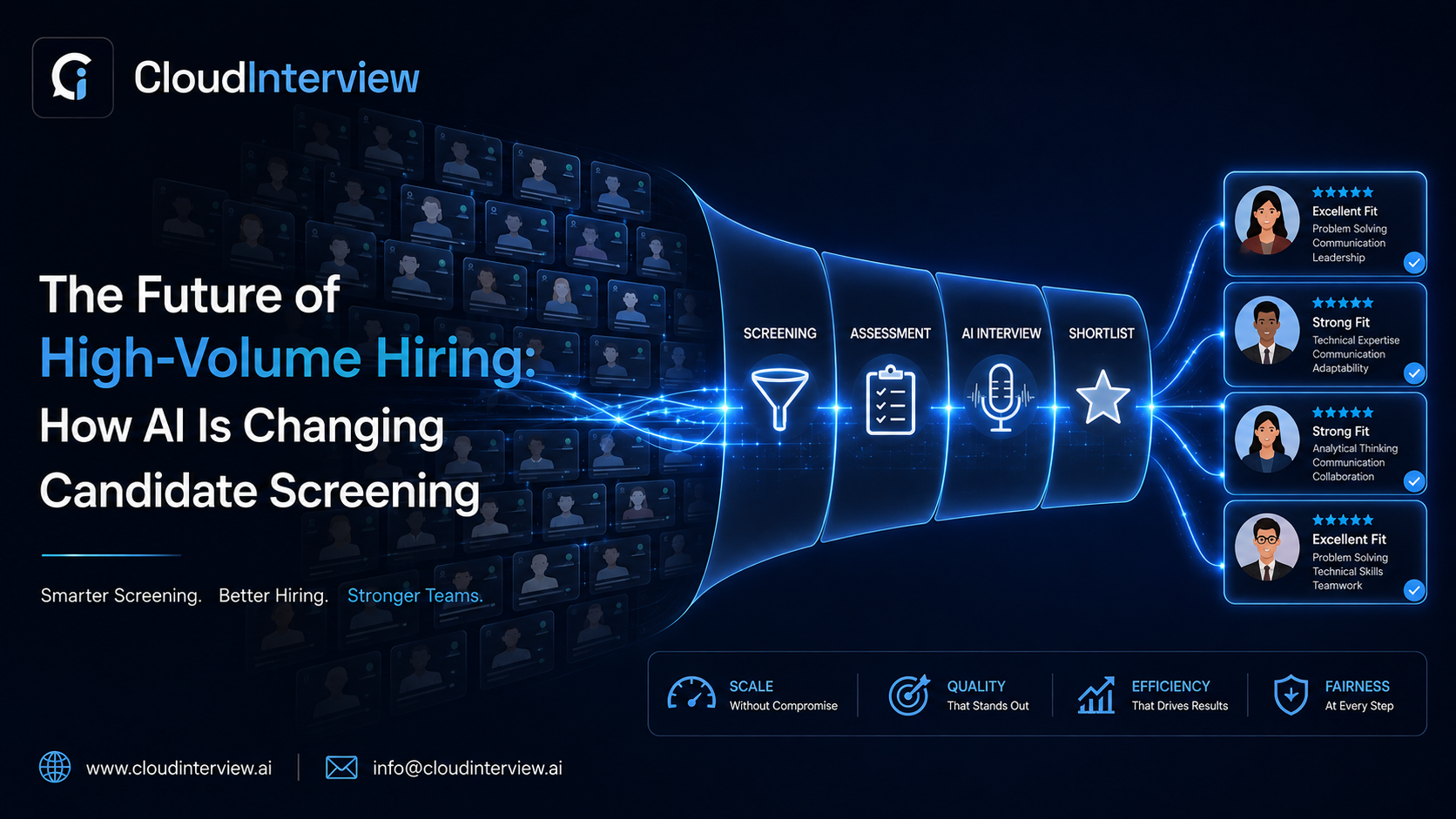
A scalable recruitment process should narrow the candidate pool gradually, increasing the depth of evaluation at each stage. A typical AI candidate screening workflow can look like this:
Application → Resume Screening → Skills Assessment → AI Interview → Recruiter Review → Human Interview
For example, a company receiving 5,000 applications could use AI-powered screening to identify candidates who meet the initial job requirements. A smaller group could then complete a skills assessment, followed by an AI interview designed around the specific role.
Recruiters can then focus their time on the strongest candidates instead of manually conducting thousands of initial screenings. The exact numbers will vary by organization, but the principle remains the same: automate repetitive screening early and reserve human expertise for later stages.
Why AI Interviews Matter in High-Volume Recruitment?
An AI interview can add another layer of candidate evaluation without requiring a recruiter to conduct every first-round interview.
Instead of asking every candidate to wait for recruiter availability, organizations can use AI-powered interviews to evaluate candidates using structured, role-specific questions.
Depending on the position, an AI interview can assess areas such as:
-
Technical knowledge
-
Problem-solving
-
Communication
-
Role-specific skills
-
Behavioral competencies
-
Situational judgment
The key is structure. Candidates should be evaluated against consistent, job-relevant criteria, making it easier for recruiters to compare results across a large candidate pool.
From Resume Screening to Real Candidate Evaluation
A resume provides useful information, but it does not tell the complete story. Modern candidate evaluation can combine multiple signals, including:
-
Resume and experience
-
Skills assessments
-
Technical tasks
-
Interview responses
-
Communication skills
-
Behavioral competencies
This multi-stage approach can provide hiring teams with a broader view of a candidate than resume keywords alone. It also helps recruiters spend less time searching through applications and more time reviewing candidates who have demonstrated relevant skills.
How to Scale Hiring Without Losing the Human Element?
AI should not mean removing humans from recruitment. The most effective AI recruiting model combines automation with human judgment. AI can help with:
-
High-volume candidate screening
-
Automated interviews
-
Skills assessments
-
Interview scheduling
-
Candidate scoring
-
Transcripts and interview summaries
-
Organizing candidate information
Recruiters and hiring managers can then focus on:
-
Reviewing qualified candidates
-
Understanding individual circumstances
-
Assessing organizational fit
-
Conducting deeper interviews
-
Making final hiring decisions
In other words: AI handles the scale. Recruiters handle the judgment.
What Should Companies Look for in an AI Interview Platform?
When evaluating an AI interview platform, hiring teams should look beyond simple automated questioning. Important capabilities can include:
Role-Specific Interviews: Questions should reflect the actual requirements of the position rather than using a generic interview for every candidate.
Structured Scoring: Candidates should be evaluated against defined competencies and criteria.
Technical Assessments: For technical positions, assessments and live coding can provide additional evidence of candidate capability.
Interview Insights: Recruiters should be able to review interview responses, transcripts, recordings, scores, and evaluation reports.
Scalability: The platform should support large candidate volumes without requiring recruiters to manually manage every interview.
Human Oversight: AI should support hiring teams, not replace appropriate human review and decision-making.
How CloudInterview Supports Hiring at Scale?
CloudInterview helps organizations streamline AI-powered candidate screening and interviews through a single platform. Hiring teams can use CloudInterview for AI screening calls, voice and video interviews, technical assessments, live coding, role-specific questions, multilingual interviews, candidate scoring, transcripts, recordings, and evaluation reports.
This allows recruiting teams to move candidates through early-stage hiring faster while maintaining a structured evaluation process. For organizations managing high-volume recruitment, the benefit is not simply conducting more interviews. It is creating a hiring process where technology handles repetitive work while recruiters spend more time evaluating the candidates who have the strongest potential.
The Future of Candidate Screening
High-volume hiring does not have to mean choosing between speed and quality. With the right combination of AI candidate screening, skills assessments, structured AI interviews, and human review, organizations can build a recruitment process that scales without turning hiring into a simple keyword-matching exercise.
The future of recruitment is not about replacing recruiters with AI. It is about giving recruiters the technology they need to screen faster, evaluate more consistently, and focus their time where human judgment matters most.
Ready to make high-volume hiring more efficient?
Discover how CloudInterview can help your team automate candidate screening and AI interviews while keeping humans at the center of the hiring process.
Start your free trial:
https://cloudinterview.ai/signup
Learn more:
https://www.cloudinterview.ai
Useful Links
AI in HR:
https://www.shrm.org/topics-tools/research/state-of-ai-hr-2026?utm_source=chatgpt.com
AI in Recruiting:
https://www.shrm.org/topics-tools/research/2025-talent-trends/ai-in-hr?utm_source=chatgpt.com
AI and Employment Decisions:
https://www.eeoc.gov/ai-and-algorithmic-fairness-initiative?utm_source=chatgpt.com
AI Risk Management Framework:
https://www.nist.gov/itl/ai-risk-management-framework?utm_source=chatgpt.com
Responsible AI Practices:
https://www.nist.gov/itl/ai-risk-management-framework/nist-ai-rmf-playbook?utm_source=chatgpt.com
U.S. Job Openings:
https://www.bls.gov/news.release/jolts.nr0.htm?utm_source=chatgpt.com
Frequently asked questions
What is AI candidate screening?
Modern AI candidate screening can go beyond simple keyword matching by considering the broader context of a candidate's experience. When combined with assessments and structured interviews, it can give hiring teams additional signals to determine which applicants should move forward.
For organizations managing high-volume hiring, AI candidate screening can reduce repetitive manual work, help recruiters process large applicant pools more efficiently, and create a more consistent initial screening process.
How does AI help with high-volume hiring?
For example, a company receiving thousands of applications can use AI to identify candidates who meet the initial requirements, invite qualified applicants to complete an assessment, and conduct structured AI interviews before recruiters review the strongest candidates.
This allows recruiting teams to spend less time on repetitive administrative tasks and more time evaluating qualified candidates, conducting deeper interviews, and making hiring decisions.
Can AI interviews replace human recruiters?
A strong AI recruiting strategy combines automation with human oversight. AI can conduct initial interviews, organize candidate information, generate evaluation reports, and highlight relevant strengths or gaps. Recruiters can then review this information and determine which candidates should progress to the next stage.
This approach allows companies to increase interview capacity without removing the human element from recruitment.
What are the benefits of using an AI interview platform?
Key benefits can include faster candidate screening, consistent interview structures, reduced recruiter workload, scalable interview capacity, and more organized candidate evaluation.
For high-volume recruitment, AI interviews can be particularly useful because candidates can complete early-stage interviews without requiring a recruiter to manually schedule and conduct every conversation. Recruiters can then focus their time on candidates who have demonstrated the qualifications and capabilities required for the role.
How can companies maintain quality when using AI for hiring?
Using structured interview questions, job-related assessments, consistent scoring criteria, and human review can help create a more reliable candidate evaluation process.
Organizations should also monitor how their AI recruiting tools are being used and regularly review the outcomes of their hiring process. AI should provide useful information to recruiters rather than becoming an unquestioned replacement for professional judgment.
The best approach is to use recruitment automation to improve efficiency while maintaining appropriate human oversight.