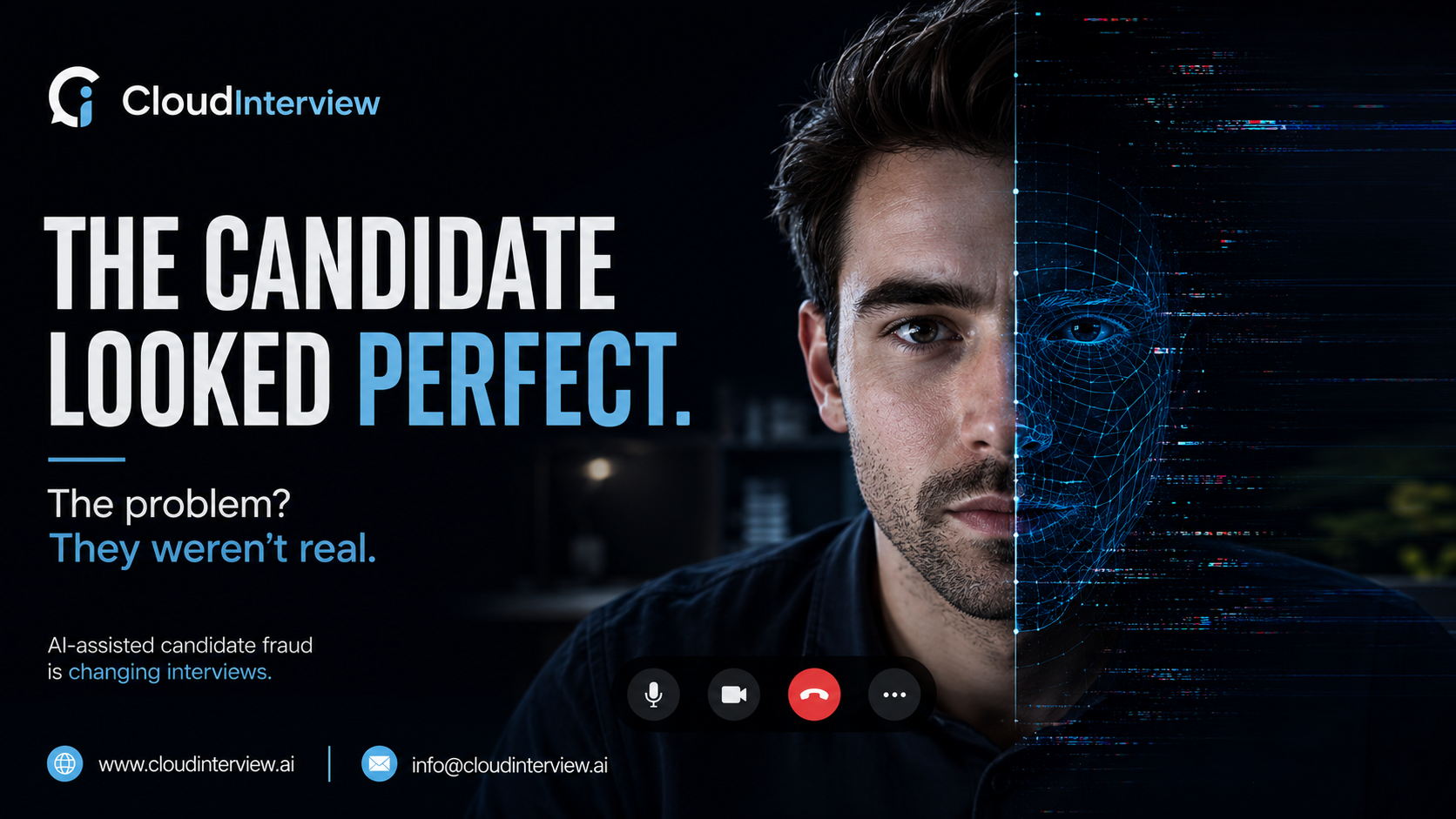
The Candidate Looked Perfect. The Problem? They Weren’t Real.
Real-time AI and deepfakes drive candidate fraud, forcing recruiters to rethink assessment methods and prioritize authentic skill verification.
The résumé looks perfect.
The experience matches the role.
The interview answers sound polished.
Everything seems right.
But recruiters now have a new question to ask:
Are we evaluating the candidate — or the AI helping them?
Artificial intelligence has already changed how companies recruit. Hiring teams are using AI to screen applications, automate repetitive processes, evaluate candidates, and manage increasingly large talent pipelines.
But AI is now sitting on both sides of the interview.
Candidates are also using AI to improve résumés, prepare answers, research employers, complete assessments, and navigate interviews.
Some of those uses are completely reasonable.
The challenge begins when AI stops being a preparation tool and starts participating in the interview itself.
AI Is Now on Both Sides of the Interview
Real-time AI assistants can generate responses while an interview is happening. Generative AI can create highly polished résumés and cover letters in seconds. Deepfake technology and identity manipulation are also creating new concerns for companies hiring remotely.
That makes one of the oldest assumptions in recruitment increasingly difficult:
The person performing well in the interview is necessarily demonstrating their own ability.
A 2026 analysis reported by Forbes looked at 19,368 AI-powered interviews conducted between July 2025 and January 2026. According to the report, 38.5% of candidates were flagged for potential AI-assisted cheating behavior. The underlying analysis came from AI interviewing company Fabric, so the figures should be considered in that context, but they highlight how seriously employers are beginning to treat interview integrity. [1]
Technical roles appeared particularly exposed, with the same analysis reporting higher flag rates among technical candidates. [1]
This doesn't mean candidates using AI should automatically be viewed with suspicion.
It does mean hiring teams may need better ways to separate AI-assisted preparation from AI-assisted misrepresentation.
The Perfect Résumé Is Becoming a Weaker Signal
For decades, the résumé has been one of the first filters in recruitment.
Today, almost anyone can use generative AI to rewrite experience, optimize keywords, improve grammar, customize applications, or turn basic information into a highly polished résumé.
That creates an important distinction.
A great application doesn't necessarily prove great capability.
Forbes, citing Gartner research, reported that nearly 40% of surveyed job applicants were using AI during parts of the application process, including résumés, cover letters, writing samples, and assessment responses. [2]
Again, AI assistance itself isn't necessarily dishonest.
The bigger issue is that recruiters can no longer rely on presentation quality alone as a strong indicator of candidate ability.
The question is shifting from:
“Does this résumé look impressive?”
to:
“Can this candidate demonstrate what this résumé claims?”
That makes the interview more important than ever.
From Candidate Screening to Candidate Verification
For years, recruitment technology has largely focused on one problem:
How can we screen more candidates faster?
That problem still exists.
But hiring teams are beginning to face another one:
How can we verify that the candidate we're assessing is authentic?
Researchers writing in Human Resource Management Review have explored the concept of the “phantom candidate” — an AI-created or manipulated identity entering a remote hiring process. Their work highlights how synthetic identities, deepfake technology, and AI-enabled deception could make authenticity verification increasingly important in remote recruitment. [3]
SHRM has also discussed the growing sophistication of AI-enabled candidate fraud and the challenge this creates for HR teams trying to maintain hiring integrity. [4]
The next generation of recruitment technology may therefore need to do more than rank applications.
It may need to help organizations understand how candidate responses were produced and whether the person behind them can genuinely demonstrate the required capability.
More Applications Don't Automatically Mean Better Hiring
AI has also made applying for jobs dramatically easier.
Candidates can customize applications faster, apply to more opportunities, and generate professional-looking materials within minutes.
For employers, this can mean much larger applicant pools.
But more applicants don't necessarily mean better hiring.
A recruiter may receive hundreds of polished applications while still having the same number of hours available to review them.
And when applications begin looking increasingly similar, finding genuine talent becomes more difficult.
The hiring bottleneck changes.
It is no longer simply:
“How do we attract enough candidates?”
It becomes:
“How do we identify the strongest candidates without interviewing everyone manually?”
That is where structured first-round screening becomes increasingly valuable.
Why This Matters for Hiring Teams
Modern recruiters are increasingly dealing with several challenges at once:
- Larger candidate pipelines
- AI-generated or highly optimized résumés
- Real-time AI interview assistance
- Proxy interviewing
- Identity and deepfake concerns
- Repetitive first-round screening calls
- Difficulty verifying genuine candidate capability
Trying to solve all of this manually can quickly become expensive and time-consuming.
The answer isn't necessarily more interviews.
It is better screening before recruiters invest their time.
Where CloudInterview Fits
Screening Faster Without Losing Visibility
CloudInterview helps organizations automate the initial candidate screening stage through AI-powered interviews.
Instead of recruiters spending hours repeatedly asking the same first-round questions, candidates can complete structured interviews without requiring constant calendar coordination.
Hiring teams can then review candidate responses, evaluations, and interview insights before deciding who should move forward.
CloudInterview also includes capabilities around candidate evaluation and malpractice monitoring, helping recruiters gain additional signals during the screening process.
The goal isn't to remove recruiters from hiring.
It's to help them focus on the part of recruitment where human judgment matters most.
Talking to the right candidates. Evaluating deeper fit. And making better hiring decisions.
AI Should Make Hiring Smarter, Not Less Human
There is an interesting contradiction emerging in recruitment.
Companies are using more AI.
Candidates are using more AI.
And sometimes, AI is effectively evaluating answers influenced by another AI.
The future of recruitment therefore isn't simply about automating everything.
The strongest hiring processes will likely combine:
Automation + Verification + Structured Evaluation + Human Judgment
Recruiters still need context.
They still need conversations.
They still need to understand motivation, personality, communication, experience, and fit.
Technology should help them reach those conversations faster.
Final Thought
AI will continue changing recruitment on both sides of the interview.
The companies that succeed won't necessarily be the ones using the most automation.
They'll be the ones using technology to create better signals, stronger verification, faster screening, and more informed human decisions.
Because finding candidates is becoming easier.
Knowing who is genuinely qualified may become the harder part.
Ready to Rethink Your First-Round Screening?
Discover how CloudInterview can help your hiring team screen candidates faster while maintaining structured evaluation and visibility throughout the interview process.
Start your free trial:
https://cloudinterview.ai/signup
Learn more:
https://www.cloudinterview.ai
Sources
[1] Forbes — “The Rise of AI Cheating Culture, And The Hiring Crisis It Left Behind”
Published August 17, 2026
https://www.forbes.com/sites/karadennison/2026/08/17/the-rise-of-ai-cheating-culture-and-the-hiring-crisis-it-left-behind/
[2] Forbes — “The Dos and Don'ts for Using AI in Your Job Search”
Published August 6, 2026
https://www.forbes.com/sites/courtney-connley-hampton/2026/08/06/the-dos-and-donts-for-using-ai-in-your-job-search-according-to-3-experts/
[3] Human Resource Management Review / ScienceDirect — “The Phantom Candidate”
https://www.sciencedirect.com/science/article/pii/S1053482226000331
[4] SHRM — “How to Navigate AI Candidate Fraud Race”
https://www.shrm.org/in/topics-tools/news/how-to-navigate-ai-candidate-fraud-race