Your Best Candidate Might Be Sleeping Right Now
Hiring shouldn’t depend on matching calendars. Discover how asynchronous AI-powered screening can help recruiters reach more candidates.
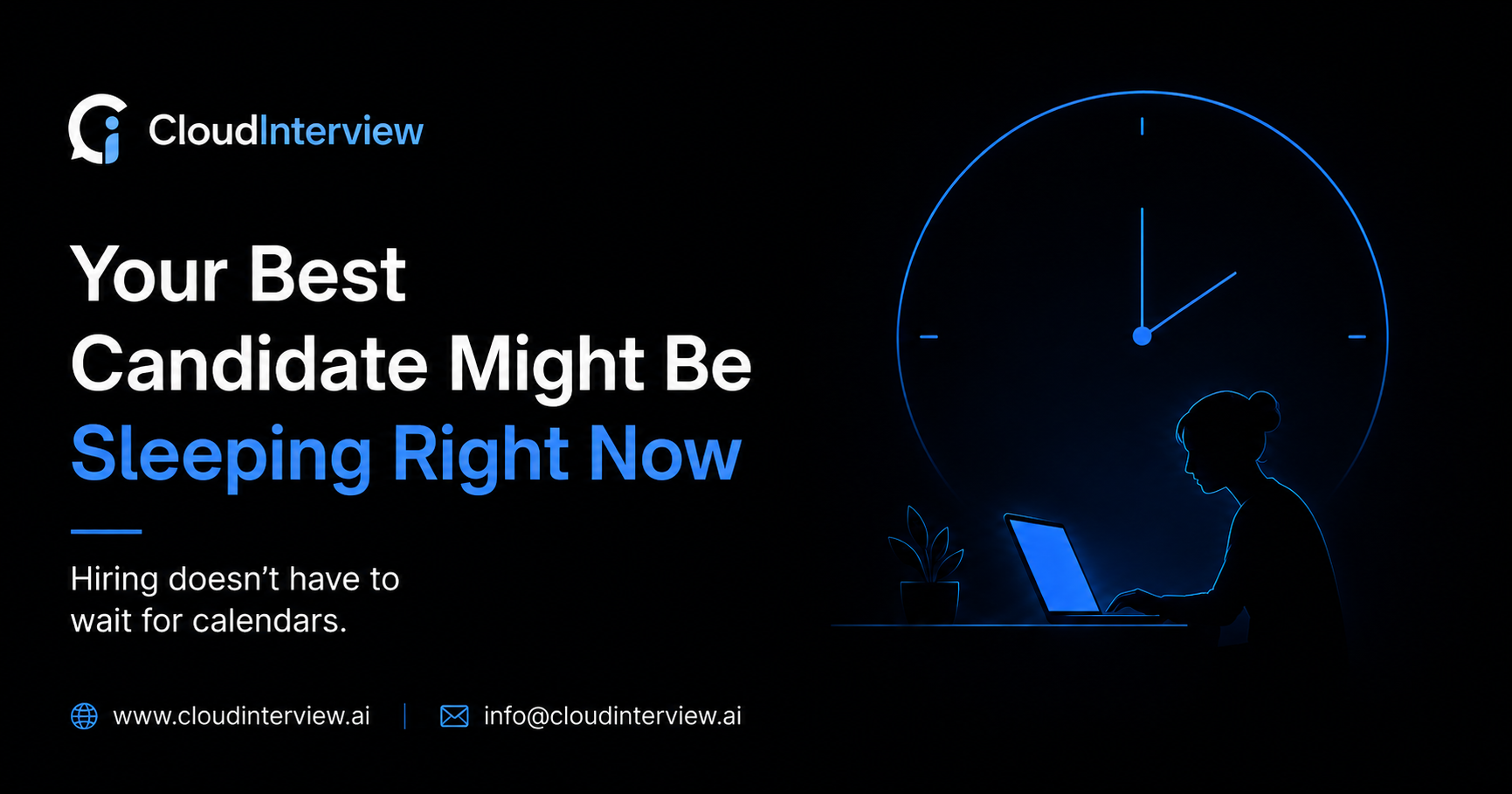
It’s 2:13 AM in New York.
Your recruiter is asleep.
A candidate in Dubai has just finished work. Another in India is getting ready for the day. All three could be part of the same hiring process, but getting everyone on the same calendar may take longer than the interview itself.
That has become one of the quieter frustrations of modern recruitment.
Companies can reach talent almost anywhere in the world, yet the first stage of hiring still depends heavily on finding one convenient 30-minute slot for two busy people.
A few emails become a scheduling link. The scheduling link becomes a reschedule. Someone misses the call. Another candidate is available only after work. By the time the interview finally happens, the candidate may already be much further along with another company.
The problem is not a lack of talent.
Sometimes, it is simply the way we are trying to meet that talent.
Hiring has evolved. Screening needs to catch up.
A single job opening can attract hundreds of applications, especially for high-volume or competitive roles.
The process that follows, however, is still surprisingly manual.
A recruiter reviews résumés, creates a shortlist, schedules introductory calls, conducts similar conversations with each candidate, takes notes and then tries to compare everyone fairly.
For a small applicant pool, that works.
For 200 candidates, it becomes exhausting.
For 2,000, it becomes difficult to scale without adding more recruiters, more hours or more delays.
And the actual interview is only part of the workload.
There are confirmation emails, cancellations, follow-ups, reschedules, repeated screening questions, note-taking and the challenge of keeping evaluations consistent across dozens of conversations.
It is not unusual for recruiters to spend a large part of their day coordinating interviews rather than actually recruiting.
That is time that could be spent speaking with promising candidates, understanding hiring managers’ needs, building relationships and making better decisions.
What if the first interview didn’t require a shared calendar?
Instead of asking a candidate to choose from a handful of available time slots, imagine simply inviting them to complete their first interview.
They could do it before work, after dinner or whenever they feel ready.
The recruiter would not need to be online at the same time.
The candidate would complete a structured interview, and the hiring team could review the responses when it suited them.
For candidates, that means greater flexibility.
For recruiters, it removes a significant amount of coordination from the first stage of hiring.
More importantly, it allows a hiring team to screen a larger group of people without filling every working hour with introductory calls.
The recruiter is still involved. The conversation has simply been moved to a point in the process where their time is more valuable.
AI should support recruiters, not replace them.
There is a tendency to talk about AI in recruitment as though its purpose is to remove people from the process.
That misses the point.
Hiring is deeply human.
Experience matters, but so do motivation, communication, personality, context and potential. Those are not decisions that should be reduced to a simple score or left entirely to a machine.
Where AI can be genuinely useful is in the repetitive parts of the process.
Organizing information. Supporting structured screening. Helping teams work through larger applicant pools. Reducing administrative work. Creating a more consistent first step for every candidate.
In other words, AI can take care of some of the groundwork so recruiters have more time for the work that requires judgment and human connection.
A useful way to think about it is as a co-pilot.
The recruiter is still making the decisions. Technology simply helps them reach those decisions with less friction.
A résumé is important. It is also incomplete.
Most hiring processes begin with a résumé, and for good reason.
A résumé gives you a useful overview of someone’s experience, education and skills.
But it cannot tell you everything.
It does not always reveal how clearly someone communicates.
It cannot fully show how a candidate approaches an unfamiliar problem.
It rarely tells you how well they can explain their thinking or how confidently they understand their area of expertise.
Sometimes a candidate who looks average on paper becomes one of the strongest people in the interview.
Sometimes the opposite happens.
That is why the first conversation matters.
The challenge is making that conversation available to more candidates without asking recruiters to personally conduct every initial screening call.
This is where CloudInterview fits in.
CloudInterview is an AI-powered interview screening platform designed to make early-stage hiring more efficient, flexible and scalable.
Hiring teams can create structured interviews that candidates complete asynchronously, without requiring both sides to be available at the same time.
Candidates have the freedom to participate when it works for them.
Recruiters can review more candidates without spending their entire week on first-round calls.
And hiring teams receive structured information that can help them decide who deserves a deeper conversation.
The technology does not replace the recruiter’s judgment.
It helps recruiters use that judgment where it matters most.
Instead of asking:
“Who can we find time to interview?”
Hiring teams can focus on a much more useful question:
“Who should we spend more time getting to know?”
That is a small shift in wording, but a significant shift in the way hiring works.
The goal is not more interviews. It is better use of everyone’s time.
Recruiters do not need more tools simply for the sake of having more tools.
They need technology that removes unnecessary work.
Candidates do not need another complicated step in an already stressful job search.
They need a process that respects their time and gives them a fair opportunity to show what they can do.
And companies do not need to interview everyone.
They need a better way to identify the people worth speaking with next.
Your next great hire could submit an application at midnight.
They could live twelve time zones away.
They could be buried somewhere in a list of hundreds of applicants.
They may not be available when your recruiter is.
None of those things should be the reason you miss them.